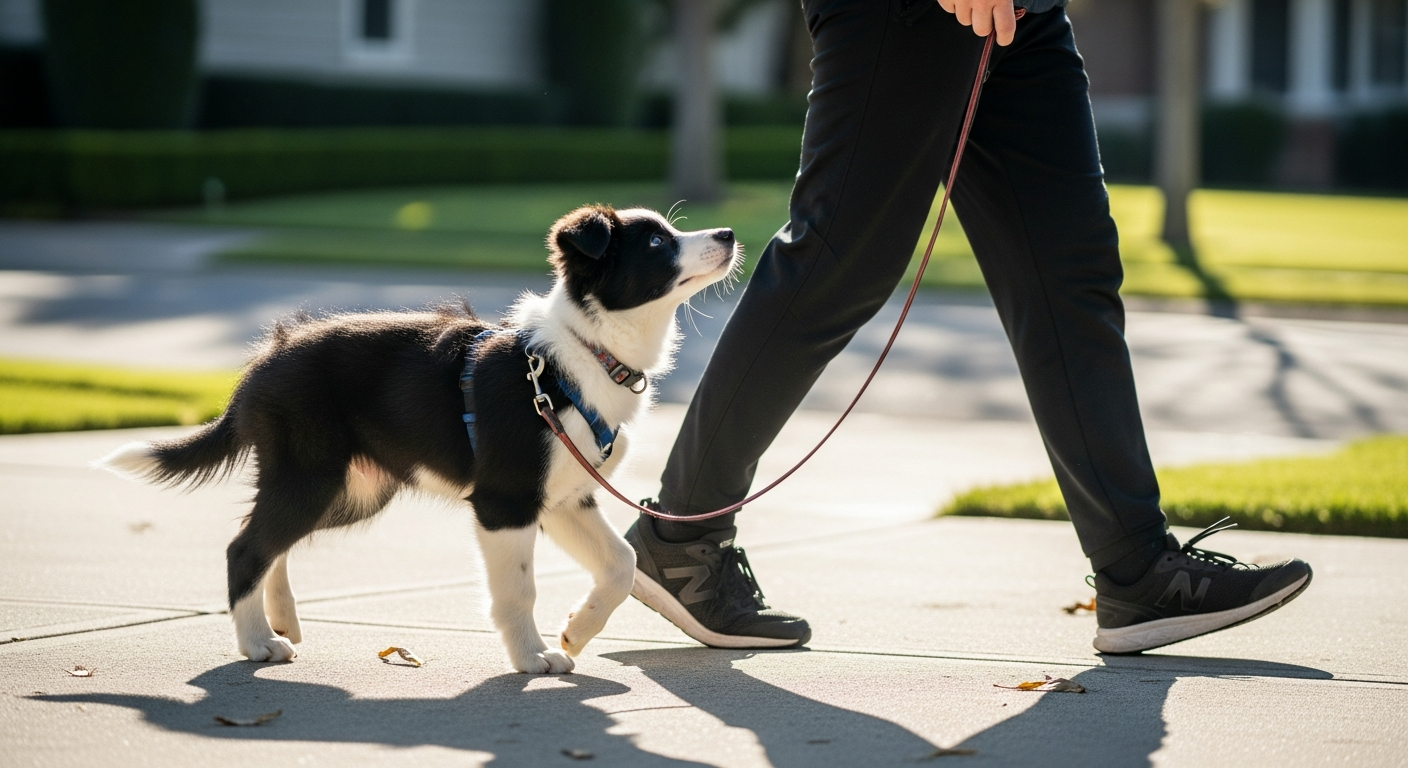
Leash training a herding breed puppy is a problem that looks simple from the outside and is genuinely complicated on the inside. The simple version is that you want the puppy to walk beside you without pulling. The complicated version is that these dogs were bred to move, to cover ground, and to make independent decisions about where to go, and you are trying to teach a behaviour that directly contradicts three centuries of selective breeding. The good news is that it can be done. The better news is that it can be done without crushing the drive you will need later for agility, disc, or actual herding work. The trade-off is that it takes longer than standard advice implies, and it has to be done in the right order.
This article covers a leash training protocol from eight weeks to six months, with specific milestones for each month. It assumes you have a healthy puppy, a flat collar or properly-fitted harness, a four-to-six-foot leash (no retractables), and high-value treats the puppy will work for. If you do not have those four things, get them before you start.
Month One: No Leash At All
The first month of leash training should happen without a leash. I know that sounds contradictory. The work is teaching the puppy to want to be near you, which is the foundation on which loose-leash walking is built. A dog who does not value your proximity will never walk nicely beside you no matter how many corrections you administer. A dog who finds you genuinely interesting will drift toward you on instinct, and the leash becomes a safety measure rather than a restraint.
In the first month, practice fifteen-minute sessions of what trainers call engagement work. Sit on the floor in a low-distraction environment. Wait for the puppy to look at you. Mark the look with a "yes" and deliver a treat. Let the puppy wander off. Wait for the next look. Mark and reward. By the end of the first week, the puppy will be checking in on you frequently. By the end of the first month, she will be offering voluntary eye contact and moving with you when you walk across the room. That behaviour is the substrate of every loose-leash walk you will ever do.
While you build engagement, introduce the leash as a neutral object. Put the flat collar on for five minutes at a time. Attach the leash, drop it on the floor, and let the puppy drag it around during play. Do this in two-minute increments and work up to ten. At no point is the leash being used to control the puppy. It is simply an item of equipment that the puppy experiences as a non-issue. The first three months guide walks through this process in the context of the puppy's broader development.
Month Two: Follow the Hand
In the second month, you introduce the idea of moving beside you in exchange for reinforcement. Pick a side (most trainers use the left because it's the traditional heel position, but right is fine if that suits your household). Hold a treat at the seam of your trousers. Walk forward two steps, deliver the treat at knee height, and stop. Walk two more steps, deliver, stop. Do this in the kitchen for two minutes at a time.
The puppy is learning that a specific position at your side is the most rewarding place in the world. This is "position work," and it is the magic of modern loose-leash training. You are not teaching "do not pull." You are teaching "be here because this is where the good stuff happens." The puppy who finds your side intrinsically reinforcing will stay there for most of a walk without needing to be told.
By mid-month two, extend to ten steps at a time. By end of month two, you can do short loops around a quiet back yard with the puppy at your side and the leash on but loose. If the puppy drifts out of position, stop walking. Wait for her to return. Mark and reward the return. Walk on. This is the mechanic that will carry you for the next six months. It is simple, repeatable, and it teaches the puppy to self-correct.
Month Three: The Front Yard Test
At month three, most puppies are ready for the quiet outdoors in front of the house. This is where herding breeds often unravel, because the sensory load outside is exponentially higher than inside. Smells, leaves, movement in the neighbour's garden - each of these is, to a Border Collie, a potential task. Your goal is to make your side more interesting than the environment.
Work short sessions in the front yard. Five minutes maximum. If the puppy is overstimulated and cannot engage with you, the session is over and you return to the house. Do not force it. Overstimulated puppies do not learn, and you will be rehearsing the exact behaviour you are trying to replace. The Association of Professional Dog Trainers publishes a useful overview of positive leash training at apdt.com that reinforces this principle.
Use a long line (twenty to thirty feet) in a safely enclosed space if you need to give the puppy more freedom to process the environment while still maintaining safety. The long line is not pulling training; it is environmental exposure training. Drop the line or hold it loosely, and let the puppy explore while you reinforce check-ins. This is how you build a dog who is both environmentally confident and engaged with you.
Month Four: The Walk Begins
By month four, assuming the previous three months have gone well, you can do actual walks on a quiet street. Start with five to ten minutes and build gradually. The walks should be heavily reinforced - a treat every five to ten steps for the first week, tapering as the behaviour becomes automatic. Never let the puppy practice pulling. If she begins to pull, stop. Stand still until the leash is loose. Mark the slack leash and take one step. Repeat. This is called the tree method, and it is maddening for the first week and then stops being necessary.
In month four you also begin to introduce the real-world variables that will test the protocol: other dogs at distance, joggers passing, children on scooters, cars. Each of these should be a practice opportunity, with the puppy rewarded for staying in position as the distraction passes. If any one variable is overwhelming, you are too close; increase the distance and try again. This is the adolescent-adjacent phase covered more deeply in the socialisation window guide.
Month Five: Duration and Distraction
At month five, the adolescent hormones start to shift, and you will see the first regression in leash behaviour. Do not panic. The dog is not broken. Adolescence compromises the prefrontal cortex's ability to apply learned behaviours in distracting environments, and loose-leash walking is the first thing to fall apart because it requires continuous self-control. Ride it out by reducing environmental intensity, increasing reinforcement rate, and returning to shorter sessions for two to four weeks until the regression passes.
By end of month five, most puppies can do a twenty-minute walk on a quiet street with intermittent reinforcement. You reward maybe every minute or every two minutes, and the behaviour holds. If the behaviour does not hold, the reinforcement rate is too thin or the environment is too hard. Back up and rebuild.
Month Six: The Real World
By month six, the protocol is mostly about generalisation. You take the behaviour to busier streets, to the edge of parks, to outside cafés, to farmers' markets. Each new environment is a new practice reset. A puppy who walks beautifully at home will struggle the first time she sees a goose. This is normal. Reinforce heavily, keep sessions short, and generalise in layers.
A word on equipment. At six months you can begin to evaluate whether a flat collar is sufficient, whether a front-clip harness would help, or whether a head halter such as a Gentle Leader is warranted. Each has trade-offs. Flat collars do not correct pulling; front-clip harnesses reduce pulling mechanically but can shape some dogs toward crabbed walking if over-used; head halters are the most control but require careful conditioning. Do not use prong or slip collars on a herding breed during this window. The breed's reactivity profile is not compatible with aversive pressure, and you will create problems that take much longer to fix than the walking they were meant to solve.
The End State
A six-month-old herding breed puppy who has been through this protocol walks on a loose leash for thirty to forty minutes at a time, checks in regularly without prompting, and can pass a moderate distraction without pulling. She is not perfect. She will still have moments. But the architecture of the behaviour is in place, and the second six months of her first year will refine rather than repair.
Leash training is unglamorous work. It is repetitive, it requires patience, and it does not produce Instagram moments. It also produces a dog you can live with for the next fifteen years, and that is worth every minute of the work. If you have spent your first month reading this site and feeling overwhelmed, start here. A dog who walks on a loose leash is a dog whose whole life gets easier, and yours does too.